Unexpected
developments force family to seek assistance
A
divorce and an unexpected child were two of the factors
that led Jennifer Burgess to seek help. Now she’s studying
to be a nurse.
By
CYNTHIA RAMNRACE
Evening
News staff writer
When
Jennifer Burgess graduated from Jefferson High School in
1991, she wasn’t sure what she wanted to do with her life.
Sick
of school, Jennifer couldn’t face starting college. She
planned instead to get a job and weigh her options. Her
parents disapproved.
"I’ll
take a year off," she said.
"You’ll
regret it," they told her.
Jennifer
got a job working in a group home, and one year folded into
another. She got pregnant, but her son Kelly’s father died.
She needed a job that paid better and got hired by a manufacturing
company in Belleville.
"
I was making $9.35 an hour," Jennifer says. "I
said darn. That’s awesome. I can’t afford to go to school
and take care of a kid. But I can work and make this really
good money."
She
met someone new and got married. They had a daughter, Kayla.
Jennifer quit her job and got hired at Tim Hortons, which
paid less but allowed her to be closer to home.
And
then, as happens sometimes, her marriage fell apart. The
divorce was painful. Their mobile home at Pleasantville
in Frenchtown Township was hers to keep and she received
child support for Kayla. Quickly she realized it wasn’t
enough to make ends meet.
"I’ve
had the best of the best and the worst of the worst,"
Jennifer says. "I’ve had diamond rings for every finger.
I sold those."
When
her husband left in 2001, Jennifer had been out of work
after having broken her ankle. There were bills that for
months had gone unpaid. The gas was shut off. The electric
bill was unfathomably high. The kids needed new clothes.
Jennifer found herself turning to her parents for help.
But what she needed was more than she could ask of them.
The time had come to go to the Monroe County Family Independence
Agency.
"I
went to them because I knew it would take time to find a
job," Jennifer says. "I didn’t know if they would
do anything. I never knew anything about welfare. It was
very rough to go down there. It was embarrassing to go down
there. My clothes were nicer. I had a nice car. I figured
these people would look at me and say, ‘yeah, right.’ "
Jennifer
didn’t qualify for cash assistance, but she did get Medicaid
coverage, food stamps and child care, which allowed her
to work.
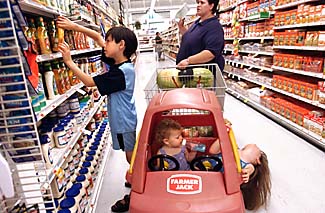
"You
don’t get a ton of food stamps," Jennifer says. "Sav-A-Lot
has been a saving grace for those of us in Monroe who have
to stretch that food dollar."
She
learned to water down the kids’ juice. She canceled the
cable TV. She pores over supermarket ad circulars. She buys
in bulk, cooks in bulk and freezes a few meals, a penny-pinching
idea she learned from a friend.
Jennifer
got a job at the Fermi 2 nuclear power plant. As a janitor,
she made $7.50 an hour. Scooping up fish flies was one of
her main responsibilities.
Then
the unexpected happened. A few months after she and her
husband separated, Jennifer got pregnant. She already had
her son, Kelly, then 7, and daughter Kayla, then 2. A new
baby would change everything.
Being
pregnant, she was uncomfortable working at a nuclear facility.
Jennifer became a telephone operator at Sensational Beginnings,
a Monroe-based children’s toy catalog.
Things
were not getting any better. Were it not for Kmart, she
doesn’t know how she would have clothed the kids, who seemed
to need new shoes every two weeks. Splurges came when the
bag for returnable bottles and cans got filled up and Jennifer
used the money to take the kids to McDonald’s, where they
could order anything they wanted off the dollar menu. Her
oldest, Kelly, who grew up wearing Tommy Hilfiger, didn’t
understand the difference between necessity and extravagance.
He wanted back all the things he used to have, like cable
TV. As a mother, Jennifer wanted to give her child those
things.
"I
realized I can’t spend the rest of my life as a telephone
operator," Jennifer says. "I thought, here I am
on my third kid. Then I heard someone on the other side
of the room mention Michigan Works! I said, what’s that?"
Michigan
Works! is an employment and job-training agency funded by
the State of Michigan. She registered and qualified to take
classes to become a medical assistant.
"I
was happy, although I regretted not being an RN," Jennifer
says.
She
went to school and worked part time as a cashier at Food
Town. Then fate entered in the form of an old high school
friend.
Jennifer
and Nicole Foland had not seen each other in years. On the
check-out line at Food Town, Nicole remembered that she
and Jennifer would talk about someday becoming nurses. Nicole
was now a registered nurse. What about Jennifer? When she
told Nicole about medical assistant training school, Jennifer
got an earful.
"You
know, for the most part, you’re not going to make any more
money than you’re making here," said Nicole, who works
with New Beginnings Mercy House, a program for women with
crisis pregnancies. "I thought you wanted to be a nurse."
"Well,
they’re paying for me to go to school," Jennifer said.
"You
need to call Michigan Works! back," Nicole told her.
Michigan Works! would pay for nursing school if Jennifer
passed the entrance exam.
"Nicole
gave me the nudge I needed," Jennifer says.
There
was a three-month waiting list to get into the Toledo School
of Practical Nursing, where Michigan Works! sends most of
its nursing school students. Jennifer waited. She took the
test, expecting the worst but hoping for the best.
"I
thought, there’s no way. I’ve been out of school for 10
years," Jennifer says. "Then I got the test back
and I got 90 percent. I said, wow, I’m not that stupid.
I told my mom. She said, ‘I never thought you were. You
just didn’t apply yourself.’"
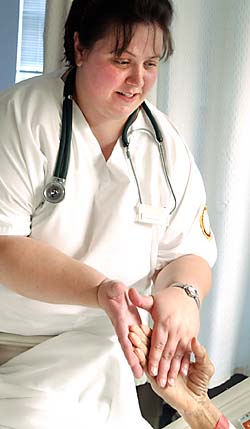
In
April of this year, Jennifer enrolled in the program that,
once she graduates, will make her a licensed practical nurse
(LPN). She was beside herself with worry. How would she
juggle raising her kids, going to school and working at
her new job, a group home in Waltz? In the first two weeks
she failed every test she took. She hadn’t yet learned how
to fit studying into the equation.
Jennifer
and the children made do each week on her $128 paycheck
from the group home (pre-tax) and $114 in child support.
That money had to pay for gas in the car to get her to school,
clothes for the kids, the utility bills and the mortgage
on her mobile home. In addition, every month she gets $300
in food stamps.
For
months, her routine was something like this: She woke at
5:30 a.m., had a glass of Pepsi for breakfast, packed her
book bag, roused the kids and took them to her mother’s,
where Kelly would wait for the school bus. She came home
at 3:15 p.m., picked up the kids, spent some time with them
before preparing dinner, helping with homework, giving baths
and putting them to bed.
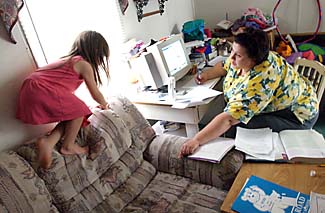
"There
was a period of time when the baby would strip naked and
sit right in the middle of my books," Jennifer says.
"I might get a paragraph or two done while they are
awake."
Once
the house was quiet, she could really settle down to study.
In her first semester she had six classes: anatomy and physiology,
pharmacology, nutrition, trends in nursing, mental health
and fundamentals of nursing.
By
1 a.m. she’d be in bed, only to repeat the routine the next
day. There was no class on Fridays, so she went to work
at the group home. She did that Saturday, too, and spent
Sundays doing laundry, spending time with the children and
if possible, attending Anchor Baptist Church.
"For
nursing school, you have to maintain a 79 average,"
Jennifer says. "You can’t be the average C student
and make it through. Surprisingly enough, I got nothing
less than an 87."
When
she saw her grades the first semester – including a high
score of 98 – Jennifer cried. She hugged her teachers. They
asked her why she was thanking them. "Because I learned,"
she said. "I thought I was way past that."
Jennifer
still struggles, but she knows she’s got more hard times
behind her than in front of her. She has since quit the
job at the group home, which has relieved a lot of stress.
Student loans are helping her to pay her bills, but things
are still tight. Kelly begs for toys he cannot have, unless
his grandparents buy them. Jennifer can’t remember the last
time she bought anything new for herself.
"When
you come to the point where you have played rearrange the
bills until you can’t rearrange the bills anymore – I’m
here," Jennifer says." How am I going to figure
out what will be paid, and what won’t? I say, I need to
give up and work. Then I say why, so I can be a worker at
Food Town for 10, 15 years and then they close up? I tell
myself, you just need to get through the next nine months."
Graduation
is even closer now. March 25 is Jennifer’s last day of class.
Then there will be licensing exams and, with any luck, job
offers. Opportunities for LPNs are better in nursing homes,
but Jennifer plans to continue her education. She wants
to be in the hospital setting, where she would be exposed
to more diverse cases.
"I’d
like to work at the VA hospital," Jennifer says. "I
think it would be neat. I’ve always been the odd one. If
it’s bottom of the barrel and no one else wants it, I want
it. Cancer, psychiatric, dialysis – they all interest me."
Jennifer’s
academic career has just begun. She plans to become a registered
nurse, get her bachelor of science degree in nursing and
finally become a nurse anesthetist, a job which in some
hospitals yields a six-figure income.
"When
I had Kelly, I had three epidurals," Jennifer says.
"(The anesthesiologist) said it was my fault because
I was fat. I thought after that, every fat girl who goes
into labor is going to have an easy time of it. Eventually,
I got the epidural. Another nurse came in and did the bolus.
It was really nice. I thought, she has a neat job. She can
deliver pain relief to anyone."
Jennifer
figures she’ll be close to 40 by the time all her schooling
is done, which will be right around the time she’ll have
to worry about paying for Kelly’s education. But those are
long-term goals. Many of the most important ones she hopes
to fulfill once she starts pulling in a paycheck. Average
starting salary for LPNs is $13.86 an hour.
"Some
days I’d like to curl up with a good book or just have an
hour to watch ‘ER’ or ‘Third Watch,’ " Jennifer says.
She’d also like a bigger home, and her own bedroom. She
now shares her room with her two daughters and Kelly has
the other bedroom. She’d like to buy some new clothes for
herself, and have a car that doesn’t constantly need repairs.
"I
can see things are getting there," Jennifer says. "I
don’t feel as helpless. There is a light. It’s not a dim
pinhole; it’s something more visible. I’m almost there."
The
kids wrestle on the floor. Inevitably, one starts crying
and another starts whining. They want her to be referee,
to pay attention. Mandi, 1, waddles into the room, a doll
in her hand and big smile on her face. Jennifer picks her
up.
"I
can honestly say no, I wouldn’t do things differently,"
Jennifer says. "Everything happened for a reason. I
have my three children and I appreciate them. Some day I
might be an example to someone else. I want to show women
what they can do. They can make it by themselves."