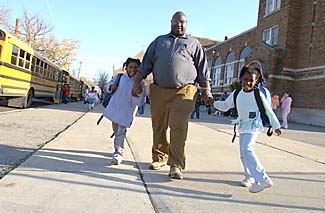
It
was a long fall, but eventually the Greer family found their
rock bottom.
By
CYNTHIA RAMNARACE
Evening
News staff writer
For
some, rock bottom would be losing a job. Or running out
of savings and being evicted from their homes. Dennis and
Pam Greer went through all that, and more. When they found
themselves with nowhere to live except for their car, they
found their rock bottom.
A
year and a half ago Dennis Greer was laid off from his job
in the computer service industry. He collected unemployment
for six months, the maximum time allowed. Then the money
he and his wife had been saving to buy a house ran out.
With
no money to pay rent, they moved in with relatives in Detroit.
But a family of six, especially a penniless one, is a huge
burden.
The
Greers had no money to buy food. They had unpaid utility
bills totaling close to $1,000. There was no health care
coverage for the children: Ashani, 9, Denise, 6, Annette,
3, and Joel, who was born in April.
So
Pam and Dennis did something they never imagined they would
do. They went to the Family Independence Agency to ask for
help.
"It
was for the kids' sake that we went," says Dennis. "If not
for the kids, we probably would have jumped in the car and
went somewhere else."
Talking
about their Wayne County FIA experience unleashes repressed
anger.
"They
don't care," Pam says. "We had an appointment. We waited
four, five hours. And then when they saw us, they had to
be smart alecks about it."
"They
make you feel like you don't want to work," Dennis says.
"And I say please. I worked for 17 years in a field I enjoy."
At
FIA they were asked detailed questions about finances and
debt. They asked Dennis why he was out of work, and what
he had done to find work. When the Greers left, they had
food assistance money, health care benefits for the children
and a toll-free number they could call for help with emergency
housing. They called, but no nearby shelter had space for
them that night. The Greer family piled into their 1985
Pontiac Parisienne, with 143,000 miles on it, and nestled
in for the night.
That
was July 14. After one night of living in their car, Dennis
and Pam were beyond desperate. They called again. In Monroe
there was a homeless shelter that could accommodate a family
of six.
"When
we heard Monroe, we said how fast can we get there?" Dennis
says.
The
car may not have been very reliable, but it got them to
Monroe. Which was a good thing, because the Salvation Army
Family Shelter does not provide transportation. The Greers
arrived at the shelter July 15. Compared to their demoralizing
experience with FIA, walking into that homeless shelter
was like coming home.
"They were nice and kind to us," Pam says. "They gave us
blankets, sheets."
It was a two-room suite, and there was a crib for Joel.
Showers, laundry and kitchen are all communal and people
are expected to help out with things like meal preparation.
For the Greers, it was a place to rest, to regroup and,
they hoped, a place where they would find their future.
Dennis
Greer, 38, had never been out of work for more than a month
when he was laid off from his job in March, 2002.
He
had worked for the same company for a while, and two years
before had accepted a transfer to Cincinnati, Ohio. He did
computer technical support - the job he was trained to do
and the one he enjoyed. The job transfer was seen as a blessing.
It got the family out of Detroit, and enabled the Greers
to raise their children in a safer environment. Things were
going well in Cincinnati. Dennis and Pam liked the city.
The kids had adjusted. They were planning to buy a house,
and were preparing to make an offer on one, when Dennis
got a phone call from his boss.
"He
called and said no, don't do that," Dennis says.
Within
a month, Dennis' company had closed its Cincinnati office.
The family was living in the suburbs. The cost of living
was high and there were no job prospects in sight. So Dennis
and Pam decided to return to Detroit, the city where they
had spent most of their lives.
"I
was devastated," Dennis says. "This was the first time I
had ever been laid off."
In
Detroit they stayed with family for a while, and then found
a house to rent. Dennis searched for a job, but the story
was always the same. No one was hiring for the position
he wanted, and he was either over or under qualified for
other jobs.
Unemployment pay helped for a while, but ran out after six
months. Then there was the savings, and little by little
the Greers chipped away at it until there was nothing left.
Then
came FIA, and a night spent six in a car, and a trip to
Monroe and feeling grateful for a homeless shelter.
Dennis
registered with Michigan Works!, a state-funded job training
and placement agency. He filled out application after application
for jobs in warehouses, in light industrial and telemarketing.
He registered with temporary agencies but never was called.
He filled out applications at Meijer, Radio Shack, McDonald's.
But his phone never rang.
In
August he was offered a job in Delaware. The company was
willing to put him up in a hotel for two weeks. Dennis wanted
to take the job, but he had to admit to himself that he
couldn't afford to get himself, his wife and four small
children there and support them until the first paycheck
came in.
"I have an 18-year-old car with 143,000 miles on it," Dennis
says. "I had $96 in my pocket to pay for food and fuel to
get down there. I wanted to take the job, but we couldn't
raise the money needed to get there."
In
their time at the shelter, the Greers tried to remain upbeat,
and to retain some sense of dignity. Pam slipped a dollar
to a teen-age girl at the shelter who watched the children
for a little bit while she took care of some chores. The
girl's face brightened in surprise, and she told Pam it
was unnecessary. But for Pam, it was.
When
asked whether he ever gets depressed, or wants to give up
the hunt, Dennis responded optimistically.
"There's
something out there for us," Dennis said then. "That's how
I feel. Even before we had to come here I wasn't afraid
of what would happen."
There
were times, after a day spent at Michigan Works!, when he
was instructed in things he already knew - how to write
a resume, that he should send a thank-you letter after each
interview - and he would need a moment to himself. He would
grab a sketchpad and markers and leave the shelter to find
a quiet place where he worked on a comic book he has written
and illustrated. And when he came back, there were always
the children's smiling faces, and the way they laugh at
what he says.